

How to Air Layer Tamarindus Indica or Sampalok
Air layering, also called marcotting, marcottage, pot layerage, circumposition and gootee, is a vegetative method of plant propagation which involves the rooting of aerial stems while attached to the parent plant. –www.cropsreview.com
Tamarindus Indica or Sampalok. I have never tried this before but a good friend of mine, Gavdencio who is also a member of the Bonsai Institute Of The Philippines Facebook group shared his experiences on this bonsai propagation method.
In his post last September 2017, he was just as eager to share his success.
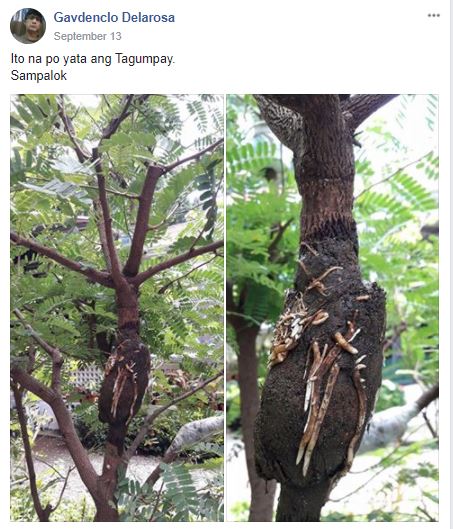
Amazing bonsai material.
I wasn’t surprised when I check the comment sections. It was flood with questions from fellow members wanting to learn how to do what he’s done to this amazing bonsai material. Unlike other locale bonsai materials, Tamarind is known to be one of the hardest to propagate as cuttings. So hobbyists resort to either hunting for yamadoris, plant seeds, or air layer. The latter is a bit tricky to perform so many members, including me are thankful to Kuya Gavdensio for sharing his best practices.
About Tamarindus Indica or Sampalok I listed all the questions in the post’s comment section together with his informative and helpful responses:
Q: How many months did it take to root?
A: 2 months
Q: Did you use any rooting hormone?
A: Yes, I used ANAA.
Q: How do I use ANAA for air layering?
A: 2-3 drops mixed with 1L of water. Use it to soak wet the planting medium.
Q: How did you do it?
A: Peel the bark of your selected branch 360° around, 1.5 inch long. Make sure that cambium is completely remove. Wet a good amount of moss with the water/ANAA solution. Remove its excess water. Place it around the peeled 1.5 innch long portion of the branch. Support it with plastic and use a string to seal it from end to end. make sure that it is air tight.
Q: Where can I get the moss use as a planting medium?
A: It is available for P10 per pack in nurseries and garden supply stores.
Q: Is it okay to defoliate the rooted portion when it is time to transfer it in a separate pot?
A: Yes, it is better if defoliated.
Q: Will it grow as a normal tree if it was propagate like that?
A: Yes, faster if planted in the ground.
Q: Which one grows faster, rooted tamarind cuttings or airlayered?
A: I am not sure if Tamarind cuttings even survive.
Conclusion
I hope you learn something from Kuya Gavdencio today. Bonsai is for everyone. It is just a matter of one’s willingness to learn the craft.
You can check the actual FB post here: https://www.facebook.com/groups/988090674572677/permalink/1495572180491188/
Thank you for taking time to read! More posts coming up. You also want to check my Youtube channel: Pinoy Bonsai


Wow, thank you so much. I live in south Florida, US and have a Tamarind tree in my back yard that I wanted to air layer for bonsai. Exactly what I needed to know!
Interested of moss can I use cockpit?